Risk Management · 2025
In this section2 topics
Risk Management Policy & Plan
Policy & Plan Description
The Company recognizes the importance of organizational risk management as a crucial foundation that enables the Company to achieve its business objectives. It also serves as a mechanism driving towards good corporate governance to achieve the organization's objectives and sustainable growth. Risk management must align with the organization's business plans and operational plans under current circumstances to achieve objectives, facilitate decision-making, and be effectively applied to other management components within the organization.
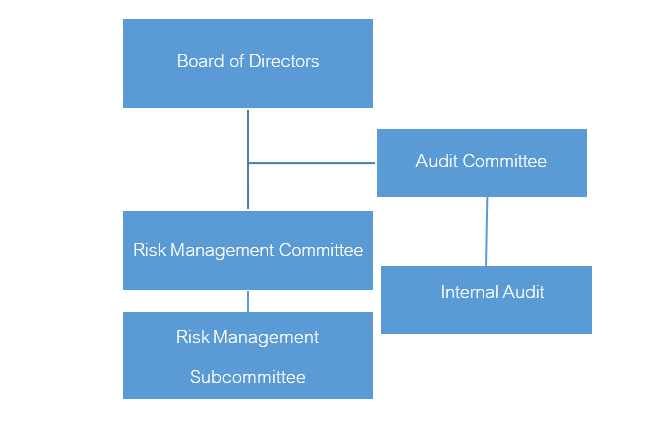
The Company has established a Risk Management Committee to oversee overall risk management for maximum effectiveness and to appropriately mitigate impacts on the Company's business. Additionally, a sub-committee for risk management has been appointed, comprising internal working groups with representatives from each department. This sub-committee is responsible for jointly defining the framework and guidelines for risk management, assessing risks, and developing risk indicators in alignment with the organization's goals and scope of responsibility.
Risk Management Framework
The risk management framework is designed to ensure efficient and effective risk operations and management, supporting alignment with the organization's goals and strategies. The Company has defined the structure and components of risk management as illustrated in the diagram below.
Audit Committee / Internal Auditor
The Audit Committee, representing the Board of Directors, is responsible for evaluating the adequacy, efficiency, and effectiveness of the organization's risk management. It reviews that the Company has appropriate internal control and internal audit systems. Furthermore, the internal auditor is assigned to assess the adequacy, reliability, and timeliness of the Company's internal control system in accordance with COSO principles, and to review audit reports and monitor the implementation of recommendations and audit findings to the Audit Committee quarterly.
Composition of the Risk Management Committee
Consists of 2 groups
Group 1: Risk Management Committee members from the Board of Directors
Group 2: Risk Management Committee members from management, by position, include:
Head of Marketing
Head of Accounting and Finance
Secretary of the Risk Management Committee
The sub-committee for risk management, comprising representatives from each department, is responsible for jointly defining the framework and guidelines for risk management, assessing risks, developing risk indicators, and recommending approaches to control and reduce risks for reporting to the Risk Management Committee.
Risk Management Process
The Company has categorized risks based on international risk management standards to serve as a guideline for risk management across all departments of the organization, as follows:
Compliance Risk (C: Compliance Risk) refers to risks arising from non-compliance with relevant regulations or laws, or regulations that hinder operations.
Financial Risk (F: Financial Risk) refers to risks arising from unpreparedness in budget and financial matters, such as exchange rates, interest rates, credit, and investments, among others.
Operational Risk (O: Operation Risk) refers to risks arising from every step of operations, covering factors related to processes, equipment, technology, information, and personnel involved in operations.
Strategic Risk (S: Strategic) refers to risks arising from the formulation of strategies and management policies, and their implementation being inappropriate or inconsistent with the organization's objectives.
Policy Document Link
https://www.tacconsumer.com/content/upload/files/RiskManagement-Policy_2568.pdf
Page Number in Report
1-7
Risks to the Company's Business Operations
Risk Register
| Risk Name | Risk Characteristics | Consequences | Management Measures | Related Risk Factors |
|---|---|---|---|---|
| Risk Form Key Customer Dependency | The Company generates revenue from the sale of products to CP All Public Company Limited, representing 93% and 89% of total sales revenue in 2024 and 2025, respectively. CPALL operates a retail convenience store business under the trademark “7-Eleven” in Thailand, with distribution channels located across all regions of the country and with continuous branch expansion each year. As of 2025, there are approximately 15,945 7-Eleven stores nationwide (source: CPALL website). Consequently, the demand for the Company’s products for distribution through these outlets has remained high and has continued to grow steadily. CPALL is also considered a financially stable and strong organization. As one of the distributors operating in close collaboration with the customer as a key strategic business partner, the Company has continuously received opportunities to develop new products in cooperation with the customer. Furthermore, the Company’s products have been available to consumers through 7-Eleven for more than 23 years. During this period, consumers have become familiar with and accustomed to the taste of the Company’s beverages, making product substitution relatively difficult. This represents a competitive advantage for the Company. Such cooperation creates mutual benefits for both parties. In addition to commercial transactions, the Company works closely with the customer through the exchange of ideas, joint business planning, and collaborative product development, including packaging design that responds effectively and promptly to customer requirements and market conditions. As a result, the Company’s sales to CPALL are not solely derived from existing products. Each year, the Company collaborates with the customer to develop new products in order to expand and better capture diverse consumer segments. Moreover, the Company has expanded its business into additional product categories beyond beverages. While the beverage business continues to grow, particularly through freshly prepared beverages available at the All Cafe corners within 7-Eleven stores and through hot beverage dispensing machines, the Company continues to explore further opportunities to broaden its product portfolio and strengthen its market presence.
| In light of the aforementioned risk, the loss of this key customer or a significant reduction in purchase volumes from such customer could materially impact the Company’s revenue and operating results. In addition, it may adversely affect the Company’s competitive position and create strategic risks to its future growth. | The Company has maintained a business relationship with CP All Public Company Limited (CPALL) for more than 23 years. This long-standing partnership demonstrates the strong confidence and trust that the customer has placed in the Company. In addition, in 2013 the Company received the Partnership Award 2013, “Best of Business Growth,” from CPALL. This award is granted to business partners who have provided excellent support and achieved outstanding business growth. Most recipients of this award are large corporations, which reflects that the Company has been recognized by its customer at a level comparable to leading organizations in the country. Furthermore, the Company was granted a three-year Exclusive Contract, which has been renewed continuously in accordance with the normal contractual cycle. Therefore, the management is confident that the Company will be able to maintain a stable and sustainable relationship with this key customer in the long term. In the B2B segment, the Company has consistently been given opportunities to grow alongside its key strategic business partners. For the B2C segment, the business has also continued to grow; however, the proportion of growth may not be as significant as B2B due to the considerably larger market size. Key operational measures include the following:
The Company recognizes the potential risk associated with reliance on a major customer. Therefore, it has implemented policies to mitigate such risk. The Company has collaborated in the development of post-mix beverages for distribution to restaurant operators within various food chain businesses. In addition, the Company places greater emphasis on expanding sales under its own brand. The Company also participates in trade exhibitions both domestically and internationally on an annual basis to promote its products, enhance brand recognition, and broaden its customer base. Furthermore, the Company conducts quarterly business plan reviews jointly with its customers. The Products Marketing Department works closely with the Research and Development (R&D) Department to develop differentiated product offerings in order to strengthen the Company’s competitive advantage. The Company also continuously participates in trade fairs and exhibitions to explore and acquire new customers. | 734 · Description: Reliance on large customers or few customers · Info category: STRATEGIC_RISK |
| Risk from Dependency Original Equipment Manufacturer | The Company primarily outsources its production to external contract manufacturers. At present, the Company engages nine principal contract manufacturers. Purchases of finished goods from these manufacturers represented 94% and 90% of the Company’s total finished goods purchases in 2024 and 2025, respectively. The increase in 2025 was mainly attributable to the launch of new products sourced from contract manufacturers. | In light of the aforementioned risk, any failure by contract manufacturers to produce products in accordance with the required quality standards, to deliver products in the agreed quantities and timelines, or to continue manufacturing products for the Company may adversely affect the Company’s business operations. | The Company places significant importance on the selection of contract manufacturers and has established clear policies and procedures for the selection and evaluation of such manufacturers. The preliminary selection criteria include manufacturing expertise, production capacity sufficient to support the Company’s orders, credibility, and financial stability. Once these preliminary qualifications are met, the relevant departments of the Company conduct further assessments, including inspections of the manufacturers’ production facilities, evaluation of production processes, trial production of sample products, and the first batch production process. The Company requires that all contract manufacturers’ facilities obtain recognized production certifications, such as Good Manufacturing Practice (GMP) and Hazard Analysis and Critical Control Point (HACCP) standards, issued by accredited certification bodies. To date, all contract manufacturers have been able to produce products in accordance with the required quality and standards and have consistently delivered products within the Company’s specified timelines. In addition, the Company has maintained strong relationships with most of its contract manufacturers for periods ranging from three to ten years. As a result, the management is confident that the Company will be able to maintain stable and long-term relationships with these manufacturers. Furthermore, the Company has designated certain key contract manufacturers and has formalized such relationships through written cooperation agreements in order to reinforce their status as strategic business partners and demonstrate a mutual commitment to conducting business together in the long term. Nevertheless, in addition to these key manufacturers, the Company occasionally engages other contract manufacturers in order to maintain good business relationships and to reduce the risk associated with reliance on a limited number of manufacturers. In particular, the production process for instant powdered beverages is relatively uncomplicated and does not require highly sophisticated technology. Therefore, it is not difficult for the Company to identify and engage alternative manufacturers that meet the required production standards. Moreover, in 2013, the Company invested in establishing its own instant powdered beverage production facility. This investment enables the Company to gain a deeper understanding of production processes, cost control, and production yield management, and enhances its ability to negotiate commercial terms with contract manufacturers more effectively. The Company has also established a pilot plant in Chonburi Province to support production capacity for its B2B business segment. In addition, the Company has expanded its production capabilities at its Ban Bueng facility by adding new production lines and upgrading production standards, thereby strengthening the Company’s overall operational capacity. The Ban Bueng facility has also received the FSSC 22000 certification for six consecutive years, a globally recognized standard for advanced food safety management and certification. From another perspective, the Company’s policy of primarily engaging external contract manufacturers also helps mitigate operational risks by diversifying its production base across multiple locations, rather than relying solely on a single production facility. The Company’s principal contract manufacturers operate factories located in Ratchaburi, Ayutthaya, Rayong, and Samut Prakan. Therefore, in the event of natural disasters occurring in a specific area, such as floods or earthquakes, the Company can shift production to other contract manufacturers’ facilities to ensure the continued supply of products to its customers. This approach also enables the Company to leverage the unique capabilities and strengths of different contract manufacturers in order to maximize operational efficiency. In addition, the Company has expanded its third production facility in Ban Bueng District, Chonburi Province, in order to further enhance production efficiency, support increasing consumer demand, and accommodate the Company’s future business expansion. | 733 · Description: Business operations of partners in the supply chain · Info category: STRATEGIC_RISK |
| Risk from Fluctuating Raw Materials Prices and Shortage of Raw Materials | The Company primarily engages external contract manufacturers for the production of its products. Purchases of finished goods from external manufacturers accounted for 94% and 90% of the Company’s total purchases of finished products in 2024 and 2025, respectively. In certain cases, contract manufacturers procure raw materials independently, while in other cases the Company purchases and supplies raw materials directly to the contract manufacturers. Nevertheless, as the Company places significant emphasis on maintaining product quality, it is responsible for selecting the manufacturers and/or suppliers of key raw materials, including tea, coffee, and milk. During the initial stage of new product research and development, the Company’s Research and Development Department selects high-quality raw materials from various manufacturers and suppliers for the purpose of developing production formulas that achieve the desired taste and product characteristics. The Company also implements quality inspection procedures for raw materials. For key raw materials, the Company conducts site visits and factory inspections of new manufacturers or suppliers prior to approving them as qualified vendors, in addition to performing annual assessments. The evaluation results are reviewed every six months, primarily based on raw material quality and delivery performance. In cases where contract manufacturers procure raw materials themselves, they are required to purchase key raw materials only from manufacturers or suppliers approved by the Company. This requirement is necessary because raw materials sourced from different suppliers may require different production formulas in order to achieve the specified taste and product characteristics. Therefore, the Company’s Research and Development Department develops alternative production formulas for approximately two to three different raw material sources in order to reduce reliance on any single supplier. The key raw materials that the Company supplies to its contract manufacturers, as well as to its own instant beverage powder production facility, include coffee, tea, sugar, and milk. Manufacturers and/or suppliers are required to submit raw material samples to the Company’s Research and Development Department for quality inspection and testing of taste and other relevant characteristics. This process ensures that the raw materials meet the Company’s established quality standards prior to procurement decisions. Furthermore, once procurement agreements have been finalized, the Company and its contract manufacturers conduct random quality inspections each time raw materials are delivered by manufacturers or suppliers, in order to ensure that the raw materials used in beverage production consistently meet the Company’s required standards. | This may directly impact the Company’s production costs and business continuity, particularly in the event of rising raw material prices, which could adversely affect the Company’s revenue and operating results. However, the Company continuously manages both direct and indirect costs to ensure optimal operational efficiency. | The Company recognizes the aforementioned risks and has therefore established policies to negotiate raw material prices in advance with domestic suppliers on an annual basis, based on the Company’s production requirements for both in-house manufacturing and outsourced production. Reservation periods are assessed based on the Company’s projected sales and production plans, and formal written purchase agreements are executed with suppliers. In addition, key suppliers are required to develop and implement risk management plans for critical raw materials. The Company’s Research and Development Department, in collaboration with the Procurement Department, also plans and tests second-source suppliers for raw materials that are used in significant quantities. The Procurement Department closely monitors market movements and trends relating to the availability and pricing of key raw materials, and provides monthly updates on price fluctuations to relevant departments. These updates are also reported to the Executive Committee during management meetings to ensure that the Company can procure sufficient raw materials at competitive prices that support efficient production costs. Furthermore, the Procurement Department continuously identifies alternative sources of high-quality raw materials and submits them to the Research and Development Department for analysis and evaluation to ensure that such alternative materials meet quality standards comparable to those currently in use. The Company also seeks additional suppliers from different geographical regions in order to secure alternative sources of raw materials with equivalent quality that can be used interchangeably in the production process. This approach provides the Company with greater flexibility in sourcing raw materials for production. In addition, the Company develops alternative production formulas in the event of shortages of critical raw materials. These measures are implemented to mitigate the potential impact of raw material shortages and to ensure the consistent taste and quality of the Company’s products. | 740 · Description: Shortage or fluctuation in pricing of raw materials or productive resources · Info category: OPERATIONAL_RISK |
| Risk from Leakage Of Secret Recipe | Given that the Company outsources the production of certain beverage products, including tea and coffee, to external manufacturers, there is a potential risk that proprietary production formulas may be disclosed by internal personnel, whether intentionally or through negligence. Such disclosure may lead to the leakage of confidential information to competitors or third parties. | The Company’s product formulations are considered critical proprietary information and must be strictly maintained as confidential. Any leakage or unauthorized disclosure of such formulations could adversely impact the Company’s business operations. | The Company strictly limits access to its production formulas and assigns coded identifiers to key raw materials and flavor components to protect proprietary information. For certain products, semi-finished ingredients (pre-mix) are supplied to contract manufacturers for final production. In addition, confidentiality provisions are clearly stipulated in all manufacturing agreements. Employees in the Research and Development Department are also required to sign confidentiality agreements to prevent the disclosure of proprietary information, including production formulas, raw material data, product information, and other related confidential information to external parties. | 745 · Description: Loss or damage from non-compliance of partners or counterparties · Info category: OPERATIONAL_RISK |
| Risk from Industry Competition | As the beverage industry continues to demonstrate strong growth potential, an increasing number of entrepreneurs and companies have shown interest in entering the market. Consequently, the level of competition within the beverage industry has intensified significantly, driven by both existing market participants and the entry of new competitors. Major industry players often possess advantages in terms of access to capital or financial support from overseas joint venture partners. In addition, they benefit from lower production costs due to large-scale manufacturing operations, resulting in economies of scale, as well as the utilization of modern machinery and advanced production technologies. Furthermore, these large operators typically have strong research and development capabilities supported by advanced technological expertise. | In light of the aforementioned risks, the Company’s competitive capability may be adversely affected. In addition, major industry participants have implemented various strategic initiatives to drive sales and strengthen their market share, which has further heightened the level of competition within the industry. | The Company’s management team has more than 23 years of experience in the beverage industry, providing them with extensive knowledge and a deep understanding of the beverage market, particularly the non-alcoholic beverage segment. In addition, the management team possesses a thorough understanding of the Company’s customer behavior and preferences, enabling the Company to formulate effective marketing strategies and management approaches that are appropriate to prevailing market conditions. The Company’s key strategic focus is on research and development to create distinctive and differentiated products. The Company also continuously develops a diverse range of products to cater to different consumer segments and to align with evolving consumer demand. Furthermore, the Company places strong emphasis on maintaining close and sincere collaboration with its trading partners through business partnerships in order to build long-term strength and achieve mutual growth. As the Company operates as a small and medium-sized enterprise (SME) with certain limitations in access to funding sources, the management team carefully analyzes the competitive landscape from multiple perspectives in order to identify potential opportunities, business gaps, and market segments in which the Company can effectively compete. As a result, the Company has been able to expand its business operations continuously. In addition, the Company reviews its business plans and product sales plans every six months. The Company conducts in-depth studies of specific customer segments (consumer insights) in order to develop products that effectively meet the needs of both customers and business partners. Market monitoring is also regularly conducted, including surveys of retail outlets, the Company’s products in the market, competitor movements, and overall market supply conditions. The Company also considers risks arising from indirect competitors, including products with similar characteristics or substitute products that consumers may choose instead of the Company’s offerings. Through these ongoing analyses, the Company aims to ensure that its products remain responsive to customer and partner needs. Based on these strategies and practices, the management believes that the Company will not be materially affected by the level of competition within the beverage industry as described above. | 728 · Description: Volatility in the industry in which the company operates · Info category: STRATEGIC_RISK · 1714 · Description: Competition risk · Info category: STRATEGIC_RISK |
| Personal Data Breach Risks (Data privacy) | In the digital era, data has become a crucial tool for creating competitive advantages in business. Many companies utilize data analysis to generate additional value for their operations. As a result, numerous businesses attempt to collect extensive amounts of data to further develop and leverage it for future benefits. However, such practices may sometimes lead to violations of consumer privacy and could potentially constitute non-compliance with the Personal Data Protection Act B.E. 2562 (2019), which may adversely affect the company’s image and reputation. | The company may face reputational and brand image damage, a loss of customer confidence, potential violations of human rights, and legal penalties, including fines and other regulatory sanctions. | The Company’s approach to managing the risk of personal data breaches begins with recognizing the importance of personal data protection. The Company places strong emphasis on respecting and safeguarding personal data rights, acknowledging that the protection of personal data is a fundamental right to privacy that must be protected under the Personal Data Protection Act B.E. 2562 (PDPA). Accordingly, the Company has established a Personal Data Protection Policy to serve as the guiding principle for safeguarding personal data and as a framework for executives and employees at all levels in the appropriate handling of personal data. The policy covers the entire process of personal data management, including the collection, use, and disclosure of personal data, the maintenance of data quality, the implementation of security measures to ensure the confidentiality and protection of personal data, and the protection of the rights of data subjects. These measures are intended to ensure that personal data is used appropriately, without violating individual privacy, and in full compliance with the provisions of the Personal Data Protection Act B.E. 2562 (PDPA). | 758 · Description: Violations of laws and regulations · Info category: COMPLIANCE_RISK |
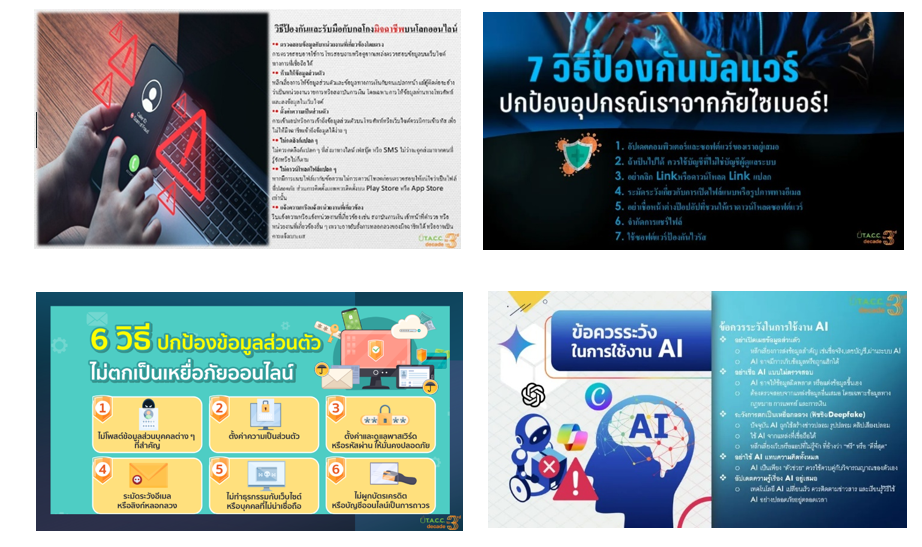
| Cyber Threat Risks | In recent years, rapid advancements in information technology-widely adopted to drive transactions and internal communications within organizations-have also created channels that facilitate increasingly sophisticated and severe cybercrime. In particular, the use of Artificial Intelligence (AI) has enabled more deceptive and highly scalable cyberattacks that can spread rapidly across wide networks. These threats continuously evolve in form and complexity, causing significant damage at both individual and national levels. Therefore, effective prevention and response require swift coordination among all relevant stakeholders, alongside the continuous strengthening of cybersecurity measures to ensure resilience and readiness in addressing emerging threats in the current digital landscape. | If a cyberattack or damage to computer systems or software were to occur, it could directly affect the Company’s business continuity, potentially causing system disruptions that prevent normal operations. Such incidents may also lead to financial losses arising from ransomware attacks, electronic fraud, or other significant cyber-related misconduct. Furthermore, these situations could damage the Company’s reputation and undermine customer confidence, particularly in cases involving the leakage of confidential business information or personal data (data breaches). | The Company has strengthened its risk management practices by emphasizing the development of a strong security culture through the Cyber Security Awareness program. This initiative aims to ensure that employees at all levels remain vigilant and well-informed about emerging cyber threats, such as email phishing and various types of malware. In addition, strict guidelines have been established for the appropriate use of information technology resources. Furthermore, the Company continuously enhances proactive cybersecurity tools and technologies, particularly through improvements to its server infrastructure and backup and data recovery systems to maximize efficiency and prevent data loss. These measures are implemented in accordance with the Company’s information security policy and emergency response plans. The Company also encourages information technology personnel to participate in advanced training programs to stay informed of evolving cyber threats and to maintain continuous monitoring and surveillance of potential risks. | 744 · Description: Information security and cyber-attack · Info category: OPERATIONAL_RISK |
| ESG Risk | The Company has integrated sustainability risk management into its business plans and corporate strategies. It has established a Sustainability Committee and an ESG (Environmental, Social, and Governance) Working Team to oversee and drive sustainability initiatives across the organization. In addition, the Company has clearly defined an ESG Framework that aligns with the Sustainable Development Goals (SDGs). The Company has also set clear ESG targets and regularly monitors the progress of ESG management. This includes the assessment of ESG-related risks and material ESG issues, which are incorporated into risk management processes at various organizational levels. Such an approach enables the Company to create opportunities and mitigate potential risks, thereby supporting its ability to generate profitability, enhance competitiveness, maintain its corporate image and reputation, and ensure the long-term sustainability of the organization. | They adversely affect the Company’s competitiveness, corporate image and reputation, business sustainability, as well as the confidence of shareholders and investors. | Environmental Risk Management
Social Risk Management
Governance Risk Management
| 1717 · Description: ESG risk · Info category: STRATEGIC_RISK |
| Corruption (Emerging Risks) | Corruption and fraud-including embezzlement, falsification, concealment, manipulation of financial reports, and the misuse of position or authority to obtain benefits for oneself or others-constitute significant problems and obstacles to the effective utilization of resources for the maximum benefit of the Company’s development. | Fraud and corruption can have significant adverse impacts on the Company, including financial losses, legal consequences, diminished stakeholder confidence, and damage to the Company’s reputation. |
| 754 · Description: Corruption · Info category: OPERATIONAL_RISK |